


Canna Provisions CEO Meg Sanders breaks down the Massachusetts Cannabis Control Commission’s 2026 regulatory reforms — wasting rule changes, shelf-stable food in dispensaries, CORI transferability, and what they actually mean for operators running cannabis retail on the ground.
This piece originally appeared as Meg Sanders’ Cannabis Corner column in the April 2026 Berkshire Business Journal and in The Berkshire Eagle. Read the original at The Berkshire Business Journal.
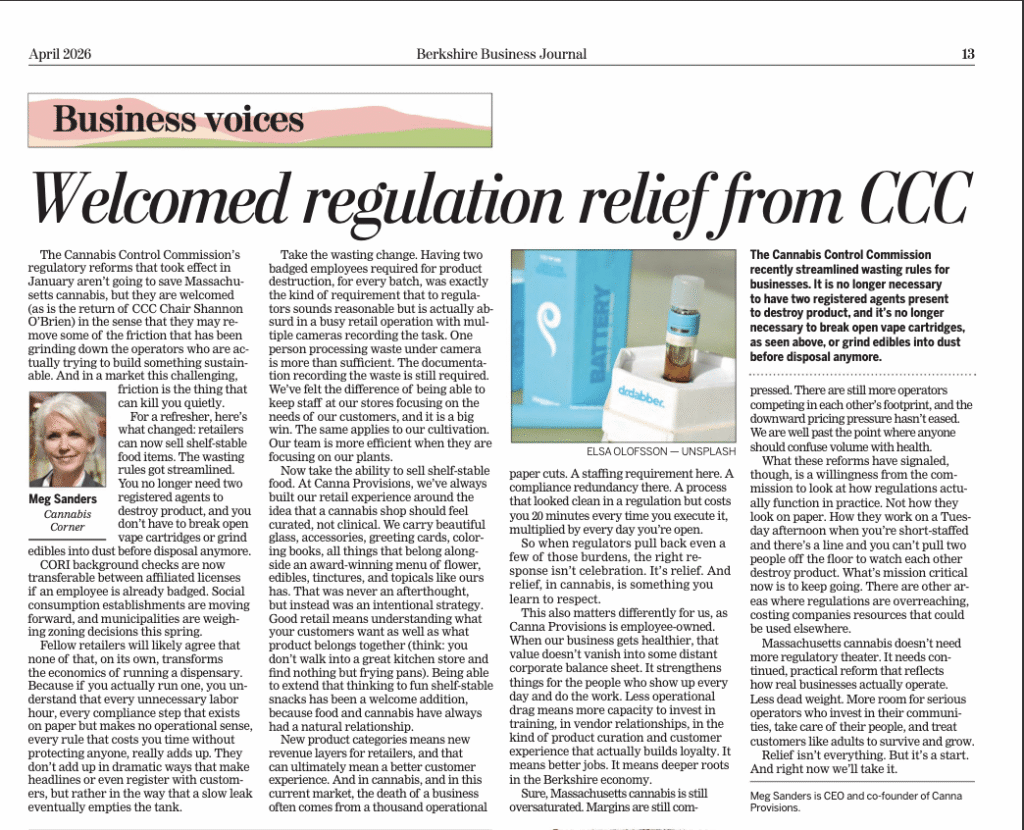
The Cannabis Control Commission‘s regulatory reforms that took effect in January aren’t going to save Massachusetts cannabis. But they are welcomed – as is the return of CCC Chair Shannon O’Brien – in the sense that they may remove some of the friction that has been grinding down the operators who are actually trying to build something sustainable. And in a market this challenging, friction eats your cashflow.
What Changed in the CCC’s 2026 Massachusetts Cannabis Reforms
For a refresher, here’s what changed under the Cannabis Control Commission’s January 2026 regulatory updates:
- Retailers can now sell shelf-stable food items alongside cannabis products.
- The wasting rules got streamlined. You no longer need two registered agents to destroy product, and you don’t have to break open vape cartridges or grind edibles into dust before disposal.
- CORI background checks are now transferable between affiliated licenses if an employee is already badged.
- A single badge for multiple licenses is coming soon.
- Social consumption establishments are moving forward, and municipalities are weighing zoning decisions this spring.
Fellow Massachusetts retailers will likely agree that none of this, on its own, transforms the economics of running a dispensary. But if you actually run one, you understand that every unnecessary labor hour, every compliance step that exists on paper but makes no operational sense, every rule that costs you time without protecting anyone really adds up. They don’t add up in dramatic ways that make headlines, or even register with customers. They add up the way a slow leak eventually empties the tank. For us, the changes above equate to thousands of dollars saved.
Massachusetts Cannabis Control Commission’s 2026 regulatory reforms: why the Wasting Rule Change Matters Most for Cannabis Operators
Take the wasting change. Having two badged employees required for product destruction, for every batch, was exactly the kind of requirement that to regulators sounds reasonable but is actually absurd in a busy retail operation with multiple cameras recording the task. One person processing waste under camera is more than sufficient. The documentation recording the waste is still required.
We’ve felt the difference of being able to keep staff at our Lee shop focusing on the needs of our customers, and it is a big win. The same applies to our cultivation. Our team is more efficient when they are focusing on our plants.
Shelf-Stable Food and the Future of the Cannabis Retail Experience
Now take the ability to sell shelf-stable food. At Canna Provisions, we’ve always built our retail experience around the idea that a cannabis shop should feel curated, not clinical. We carry beautiful glass, accessories, greeting cards, coloring books – all things that belong alongside an award-winning menu of flower, edibles, tinctures, and topicals like ours has.
That was never an afterthought. It was an intentional strategy. Good retail means understanding what your customers want as well as what product belongs together. (Think about it: you don’t walk into a great kitchen store and find nothing but frying pans.) Being able to extend that thinking to fun shelf-stable snacks has been a welcome addition, because food and cannabis have always had a natural relationship.
New product categories mean new revenue layers for retailers, and that can ultimately mean a better customer experience. Drop into our Holyoke store, our Lee shop, or our newest store in Pittsfield near Bousquet Mountain and you’ll see how the curation actually plays out on the shelf.
Death by a Thousand Paper Cuts: The Operational Reality of Cannabis Retail
In cannabis, and in this current Massachusetts market, the death of a business often comes from a thousand operational paper cuts. A staffing requirement here. A compliance redundancy there. A process that looked clean in a regulation but costs you 20 minutes every time you execute it, multiplied by every day you’re open.
So when regulators pull back even a few of those burdens, the right response isn’t celebration. It’s relief. And relief, in cannabis, is something you learn to respect.
What These Reforms Mean for an Employee-Owned Dispensary
This also matters differently for us, as Canna Provisions is employee-owned. When our business gets healthier, that value doesn’t vanish into some distant corporate balance sheet. It strengthens things for the people who show up every day and do the work.
Less operational drag means more capacity to invest in training, in vendor relationships, in the kind of product curation and customer experience that actually builds loyalty. It means better jobs. It means deeper roots in the Berkshire economy. As we wrote elsewhere this spring, being more than a dispensary only works if the underlying business has the breathing room to act on those values.
What’s Still Broken in Massachusetts Cannabis Regulation
Massachusetts cannabis is still oversaturated. Margins are still compressed. There are still more operators competing in each other’s footprint, and the downward pricing pressure hasn’t eased. We are well past the point where anyone should confuse volume with health.
What these reforms have signaled, though, is a willingness from the Commission to look at how regulations actually function in practice – not how they look on paper, but how they work on a Tuesday afternoon when you’re short-staffed and there’s a line and you can’t pull two people off the floor to watch each other destroy product. The mission-critical work now is to keep going. There are other areas where regulations are overreaching, costing companies resources that could be used elsewhere.
Massachusetts cannabis doesn’t need more regulatory theater. It needs continued, practical reform that reflects how real businesses actually operate. Less dead weight. More room for serious operators who invest in their communities, take care of their people, and treat customers like adults to survive and grow.
Common Questions About the CCC’s 2026 Massachusetts Cannabis Reforms
What changed in Massachusetts cannabis regulations in January 2026?
The Massachusetts Cannabis Control Commission (CCC) implemented several operator-friendly regulatory updates in January 2026: dispensaries can now sell shelf-stable food, the product wasting protocol now requires only one badged employee instead of two and no longer requires breaking open vape cartridges or grinding edibles before disposal, CORI background checks are transferable between affiliated licenses, single-badge multi-license credentials are coming soon, and social consumption establishments are moving forward at the municipal-zoning level.
Can dispensaries sell food in Massachusetts now?
Yes. Under the Massachusetts Cannabis Control Commission’s 2026 regulatory reforms, Massachusetts cannabis retailers can sell shelf-stable food items alongside cannabis flower, edibles, tinctures, vapes, and accessories. Cannabis-infused edibles are a separate regulated product category and have always been part of the licensed dispensary menu. The new rule lets dispensaries also stock conventional non-infused shelf-stable snacks that complement the retail experience.
Who is the current chair of the Massachusetts Cannabis Control Commission?
Shannon O’Brien returned as Chair of the Massachusetts Cannabis Control Commission. Her return coincided with the rollout of the January 2026 regulatory reforms, which industry observers including Marijuana Moment have flagged as a constructive shift in tone between the CCC and Massachusetts cannabis operators.
Visit Canna Provisions in the Berkshires and Pioneer Valley
Relief isn’t everything. But it’s a start. And right now we’ll take it. The Massachusetts Cannabis Control Commission’s 2026 regulatory reforms were welcomed by operators like Canna Provisions.
If you want to see how a Berkshire-based, employee-owned cannabis operator builds a retail experience around the idea that dispensaries should feel curated and not clinical, stop in at any of our locations.
Visit Canna Provisions: Lee, MA | Holyoke, MA | Pittsfield, MA (near Bousquet Mountain)
This column originally ran in the April 2026 Berkshire Business Journal and in The Berkshire Eagle, under the byline of Meg Sanders, CEO and co-founder of Canna Provisions.
Related Reading

Canna Provisions © 2026
Site by CannaPlanners