


Cannabis is the one retail category where inflation-based prices keep falling even as operator costs climb. For dispensaries in Massachusetts, that creates a trust problem, a margin problem, and a real survival risk for the legal market—and panic-discounting makes every one of those problems significantly worse.
This piece originally appeared as Meg Sanders’ Cannabis Corner column in the June 2026 Berkshire Business Journal and in The Berkshire Eagle. Read the original in the Berkshire Business Journal’s June 2026 issue and read the original at The Berkshire Eagle.
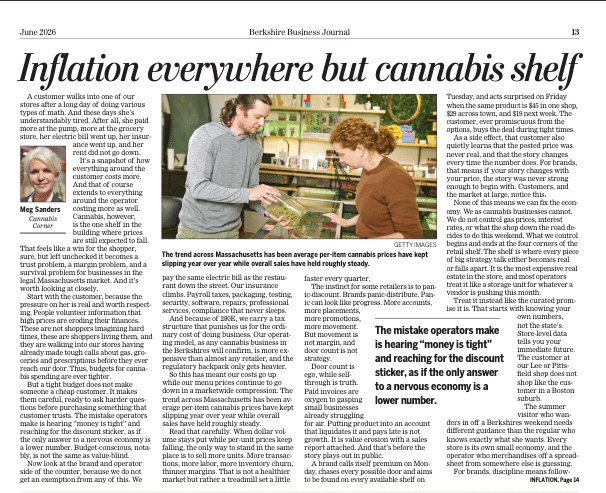
A customer walks into one of our stores after a long day of doing various types of math. And these days she is understandably tired. She paid more at the pump, more at the grocery store, her electric bill went up, her insurance went up, and her rent did not go down.
It is a snapshot of how inflation makes everything around the customer cost more. And that extends to everything around the operator costing more as well. Cannabis, however, is the one shelf in the building where prices are still expected to fall. That feels like a win for the shopper—but left unchecked, it becomes a trust problem, a margin problem, and a survival problem for businesses in the legal Massachusetts market. It is worth looking at closely.
The Customer Is Under Real Pressure—And She Knows It
Start with the customer, because the pressure on her is real and worth respecting. People are openly volunteering that high prices are eroding their finances. These are not shoppers imagining hard times. They are living them, walking into our stores having already made tough calls about gas, groceries, and prescriptions before they ever reach our door. Cannabis budgets are tighter for it.
But a tight budget does not make someone a cheap customer. It makes them careful—ready to ask harder questions before buying something they trust. The mistake operators make is hearing “money is tight” and reaching for the discount sticker, as if the only answer to a nervous economy is a lower number. Budget-conscious is not the same as value-blind.
Why Inflation-driven Cannabis Dispensary Operating Costs Keep Climbing in Massachusetts
Look at the operator side of the counter, because cannabis businesses do not get an exemption from any of this. We pay the same electric bill as the restaurant down the street. Our insurance climbs. Payroll taxes, packaging, testing, security, software, repairs, professional services, compliance that never sleeps. And because of IRS tax code 280E, cannabis businesses carry a tax structure that punishes ordinary business expenses. Our operating model—as any cannabis business in the Berkshires will confirm—is more expensive than almost any comparable retailer, and the regulatory cost only adds weight.
So costs go up while menu prices keep going down. The trend across Massachusetts cannabis has been consistent: average per-item prices slipping year over year while overall sales hold roughly steady. Read that carefully. When dollar volume stays flat while per-unit prices keep falling, the only way to hold your position is to sell more units. More transactions, more labor, more inventory churn, thinner margins. That is not a healthier market. That is a treadmill set a little faster every quarter.
[IMAGE: Canna Provisions budtender helping customer select cannabis product | Alt: Canna Provisions cannabis dispensary staff helping customer Massachusetts Berkshires retail]
Why inflation Panic-Discounting Is the Wrong Answer to Price Compression
The instinct for some retailers is to panic-discount. Brands panic-distribute. Panic can look like progress—more accounts, more placements, more promotions, more movement. But movement is not margin, and door count is not strategy. Door count is ego. Sell-through is truth. Paid invoices are oxygen to small businesses already gasping for air. Putting product into an account that liquidates it and pays late is not growth. It is value erosion with a sales report attached.
A brand calls itself premium on Monday, chases every available shelf on Tuesday, and acts surprised on Friday when the same product is $45 in one shop, $29 across town, and $19 next week. The customer buys the deal. As a side effect, she quietly learns that the posted price was never real, and that the story changes every time the number does. If your story changes with your price, the story was never strong enough to begin with. Customers—and the market—notice this.
What “Solving the Shelf” Actually Means for Cannabis Retailers
None of this means cannabis businesses can fix the economy. We cannot. We do not control gas prices, interest rates, or what the shop down the road does this weekend. What we control begins and ends at the four corners of the retail shelf. The shelf is where every piece of big strategy talk either becomes real or falls apart. It is the most expensive real estate in the store, and most operators treat it like a storage unit for whatever a vendor is pushing this month.
Treat it instead like the curated promise it is. That starts with knowing your own numbers—not the state’s. Store-level data tells you your immediate future. The customer at our Lee or Pittsfield shop does not shop like a customer in a Boston suburb. The summer visitor who wanders in off a Berkshires weekend needs different guidance than the regular who knows exactly what she wants. Every store is its own small economy. The operator who merchandises off a spreadsheet from somewhere else is guessing.
For brands, discipline means following your product onto the shelf. Know where it sits, what it sits next to, how it is priced, and whether the staff can actually explain it. Protect your pricing where you legally can, and walk away from accounts whose only model is the bargain bin. For retailers, discipline means the shelf earns its keep. Fresh product, honest pricing, a menu that makes sense, and a team that can turn a careful customer into a confident one. Pull what does not move or what your people cannot stand behind.
Why the Berkshires Cannabis Market Demands a Higher Standard
I think about it the way I think about a good restaurant. You would not eat somewhere the chef refuses to eat. Our budtenders should never hand a customer something they would not recommend to a friend, and a shopper under real financial pressure should never have to gamble on whether the staff believes in what they are selling. That confidence is the product. The flower, the edibles, the vapes—those are just what the customer carries home.
In the Berkshires, this matters more than almost anywhere. Locals, tourists, wellness shoppers, first-timers, and longtime consumers all cross paths in the same room, and word travels fast in a place this size. We do not get to run a lazy retail operation and blame the economy when people do not come back. The shelf has to make sense to all of them, in season and out.
The consumer pressure is real. The price compression is real. The answer is not to shout “sale” the loudest—it is to know your numbers, train your people, price with a spine, and choose partners who protect value instead of torching it. The operators who make it through this next stretch will be the ones who understand that trust is built in small moments, repeated well.
Cannabis does not need to solve the economy. It needs to solve the shelf.
[IMAGE: Canna Provisions dispensary exterior Berkshires Massachusetts | Alt: Canna Provisions cannabis dispensary exterior Massachusetts Berkshire County retail location]
Common Questions About inflation in Cannabis Pricing and Retail Strategy in Massachusetts
Why are cannabis prices falling in Massachusetts even as everything else gets more expensive?
Massachusetts cannabis has seen consistent year-over-year per-item price declines even as overall sales volume holds relatively steady—a sign of market-wide price compression driven by oversupply, aggressive discounting, and competition. At the same time, dispensary operating costs (payroll, compliance, testing, insurance, security, and federal tax code 280E) continue rising. The result is a shrinking margin environment that hits independent operators harder than well-capitalized chains.
What is IRS tax code 280E and how does it affect cannabis dispensaries?
280E is a federal tax provision that bars cannabis businesses from deducting ordinary business expenses—payroll, rent, utilities, marketing—because cannabis remains federally classified as a controlled substance. This means Massachusetts dispensaries pay federal taxes on gross profit rather than net income, creating a significantly higher effective tax rate than any comparable retail business. It is one of the core structural reasons cannabis operating costs are so much higher than they appear from the outside.
How can cannabis retailers compete without racing to the bottom on price?
The alternative to discount competition is disciplined curation: knowing your store-level data, stocking a menu your staff can genuinely stand behind, building a customer experience that earns loyalty rather than buying transactions, and partnering with brands that protect their own pricing. Trust, built through consistent hospitality and honest product representation, outperforms promotional pricing over any meaningful time horizon—especially in close-knit markets like the Berkshires where word travels fast.
Looking for a cannabis retail experience built on curation, trained staff, and honest pricing? Visit us at our Pittsfield, Lee, and Holyoke locations—open seven days a week.
This column originally ran in the June 2026 Berkshire Business Journal and in The Berkshire Eagle, under the byline of Meg Sanders, CEO and co-founder of Canna Provisions. Read the original feature at The Berkshire Eagle.
Related Reading


Canna Provisions © 2026
Site by CannaPlanners