
In order to know how to decarb weed, preheat your oven to 240°F (115°C), break up cannabis flower into rice-size pieces, spread it in a single layer on a parchment-lined baking sheet, and bake for 30 to 40 minutes until the flower turns light golden-brown and toasted. Decarboxylation activates THC for edibles, tinctures, and topicals by converting non-psychoactive THCA into the psychoactive THC your body can absorb. In Massachusetts, adults 21 and older can legally decarb cannabis purchased from licensed dispensaries for personal home use.
If you are planning to make cannabis edibles, cannabutter, tinctures, or infused oils at home in Massachusetts, decarboxylation is the one step you cannot skip. Raw cannabis flower contains very little THC — it is mostly THCA, a non-psychoactive acid that your body cannot efficiently absorb. Heat transforms THCA into THC, which is what actually produces the effects you are cooking for.
This guide walks through everything you need to know to decarb cannabis the right way: the science behind why it works, the exact temperatures and times that deliver the best results, a step-by-step oven method, a low-and-slow alternative, common mistakes to avoid, and Massachusetts-specific guidance on sourcing flower and staying compliant with state cannabis law.
And if you are looking for purchasing recreational cannabis that has already been decarboxylated, shope for pre-activated flower at our stores!
Browse our menus: Lee Menu | Holyoke Menu | Pittsfield Menu
What Is Decarboxylation and Why Does It Matter?
Decarboxylation is the chemical process of removing a carboxyl group (COOH) from cannabinoid acids through heat, converting them into their active forms. In cannabis, this most importantly means converting THCA into THC and CBDA into CBD. Without decarbing, most homemade edibles and infusions will not produce the effects you are expecting — the raw flower is essentially inert for oral consumption.
When you smoke or vaporize cannabis, decarboxylation happens instantly at the high temperatures of combustion or vaporization. That is why smoking flower gets you high and eating the same flower raw does not. But when you are cooking with cannabis or making tinctures, you need to decarboxylate deliberately and carefully — before infusing the flower into a fat like butter, coconut oil, or MCT oil.
This step also enables accurate dosing. Once your cannabis is decarbed, you can reliably calculate how much THC you are working with based on the lab-tested potency on the packaging from your Massachusetts dispensary. That math is how you go from “some edibles” to “a tray of 5 mg gummies” — and it is the difference between a predictable, enjoyable experience and an uncomfortable one.
The Science: Ideal Decarboxylation Temperature and Time
The ideal decarboxylation temperature for THC activation is between 220°F and 240°F (104°C to 115°C). This range is backed by peer-reviewed research. A 2016 study published in the Journal of Chromatography A by Wang and colleagues demonstrated that THCA decarboxylation reaches maximum efficiency between 105°C and 120°C. A separate study published in Industrial & Engineering Chemistry Research identified 230°F to 250°F (110°C to 121°C) for 30 to 40 minutes as the range for near-complete THCA conversion while minimizing THC degradation.
Translation for home cooks: 240°F for 30 to 40 minutes is the reliable sweet spot most experienced cannabis cooks use. Go too low and you underactivate your flower. Go too high and you start degrading the THC you worked to activate, and you burn off the terpenes that give your end product flavor and nuanced effects.
Cannabis Decarboxylation Temperature and Time Chart
Different methods and goals call for different temperature and time combinations. Here is a reference chart based on published research and home cooking experience:
- Low and slow (THC, maximum terpene preservation): 220°F (104°C) for 60 minutes
- Standard method (THC, balanced): 240°F (115°C) for 30 to 40 minutes
- Quick method (THC, higher degradation risk): 265°F (129°C) for 7 to 10 minutes — not generally recommended
- CBD activation (hemp or CBD-rich strains): 245°F (118°C) for 45 minutes — CBDA needs slightly higher temperature and longer time than THCA
- Full-spectrum (THC and CBD together): 240°F (115°C) for 40 to 45 minutes
For most home users making THC edibles from Massachusetts dispensary flower, stick with 240°F for 30 to 40 minutes. It is forgiving, consistent, and produces the best balance of potency and flavor.
How to Decarb Weed: Step-by-Step Oven Method
The oven method is the gold standard for home decarboxylation. It is simple, reliable, and works with any kitchen oven. Here is exactly how to do it.
What You Will Need
- 1/8 ounce (3.5 grams) to 1 ounce (28 grams) of cannabis flower from a licensed Massachusetts dispensary
- A baking sheet
- Parchment paper (not wax paper — wax paper can melt and smoke)
- An oven thermometer (strongly recommended, since home oven temperatures often run 15-25°F off their settings)
- A timer
- Optional: an airtight glass jar for storage
Step 1: Preheat the Oven to 240°F
Set your oven to 240°F (115°C) and let it fully preheat. Home ovens vary in accuracy, so using a separate oven thermometer is the single best thing you can do to get consistent results. Even a 20-degree swing can push you from perfect decarb into degradation territory.
Step 2: Break Up the Flower
Break your cannabis into pieces roughly the size of a grain of rice. You can do this by hand, with scissors, or with a pulse or two in a grinder. Do not grind it into a fine powder — finely ground cannabis burns faster and unevenly, and it can also be harder to strain later if you are making infusions.
Step 3: Spread in a Single Layer
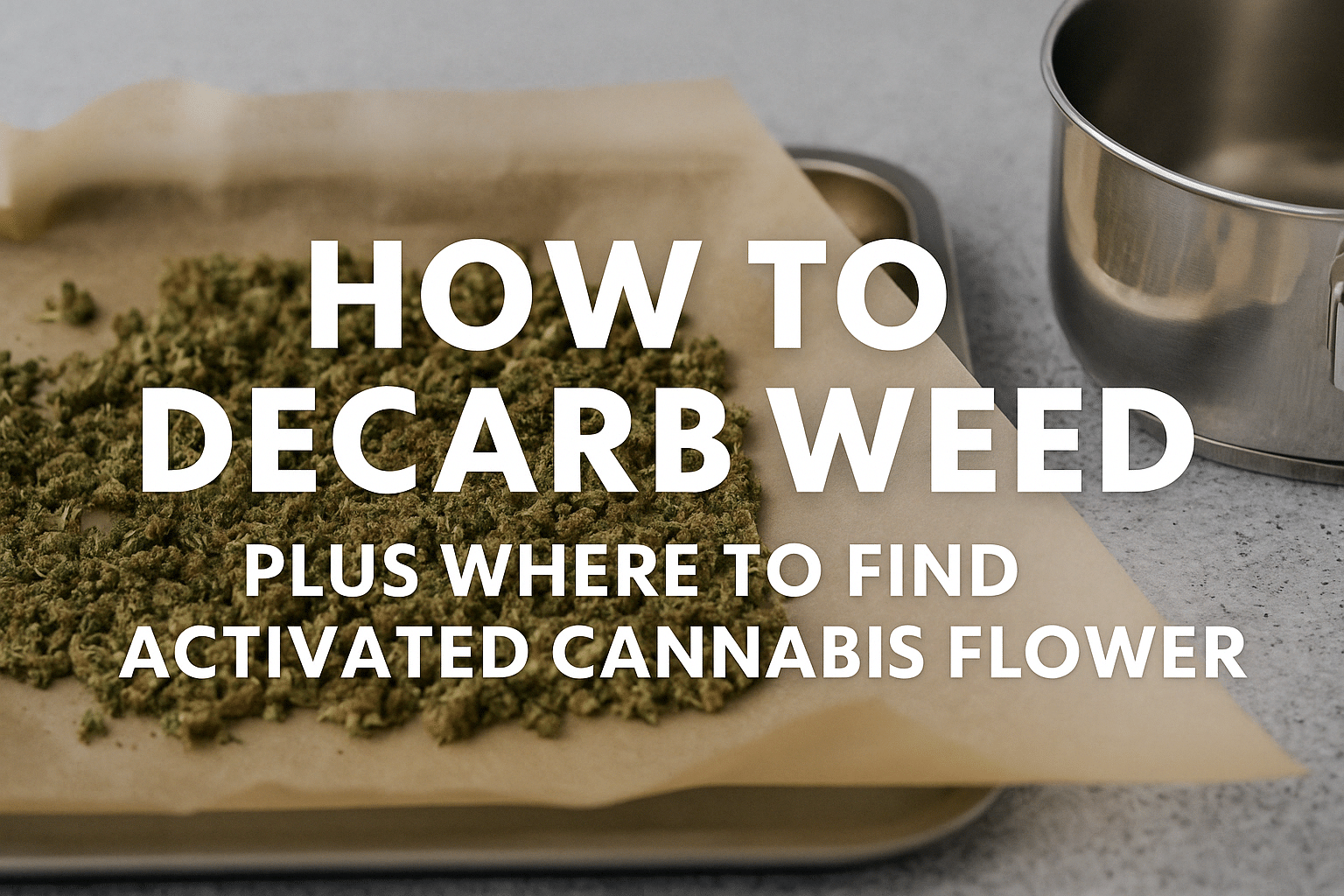
Line your baking sheet with parchment paper. Spread the broken-up flower in a single, even layer across the sheet. You want all the flower exposed to even heat, which means no overlap and no piles.
Step 4: Bake for 30 to 40 Minutes
Place the sheet in the middle rack of your preheated oven. Bake for 30 to 40 minutes at 240°F. Stir or gently shake the pan once around the 15-minute mark and again around the 25-minute mark to make sure all the flower heats evenly. Your kitchen will smell strongly of cannabis during this process — crack a window or run an exhaust fan if that matters to your household.
Step 5: Check for Doneness
Properly decarbed cannabis turns a light golden-brown and has a slightly toasted aroma. It should look dry and crumbly, not scorched or dark brown. If it is still green and fresh-looking, give it another five minutes. If it is dark brown or black, you have gone too far — the THC is degrading and you are losing potency.
Step 6: Cool Completely Before Using or Storing
Let the flower cool completely on the pan before handling. The parchment paper will collect any stray trichomes and cannabinoid residue, so do not throw it away until you have scraped it clean into whatever you are infusing. Once cool, your decarbed cannabis is ready to be infused into butter or oil, used in tinctures, or stored in an airtight glass jar in a cool, dark place for up to 3 to 6 months.
Alternative Method: Low-and-Slow Decarboxylation
If you want to maximize terpene preservation for a more flavorful end product, the low-and-slow method at 220°F (104°C) for 60 minutes is an excellent alternative. The lower temperature preserves more of the volatile terpenes that give cannabis its flavor and contribute to the entourage effect. The tradeoff is that it takes longer, and you need to be patient.
The steps are identical to the oven method above — just drop the temperature to 220°F and extend the bake time to a full hour, stirring every 20 minutes.
Mason Jar Method for Odor Control
If you are decarbing in a shared living space or want to minimize the strong cannabis aroma during baking, the mason jar method is a good option. Break up your cannabis as usual, place it in a wide-mouth mason jar with the lid loosely resting on top (not sealed tight — pressure can build up), and place the jar on its side on a baking sheet in the oven at 240°F for 60 minutes. Rotate the jar every 15 minutes to ensure even heat distribution.
The jar traps most of the aroma and terpenes, which many users report produces a more flavorful decarb. Just be careful handling the hot jar, and never fully seal the lid during baking.
Common Decarboxylation Mistakes and How to Avoid Them
Most home decarb failures come down to temperature or timing errors. Here are the most common mistakes we hear about from customers at our Lee, Holyoke, and Pittsfield dispensaries, and how to avoid them.
Trusting Your Oven’s Thermostat
Home ovens are notoriously inaccurate. A recent survey of home ovens found that many run 15 to 25°F above or below their set temperature. A $10 oven thermometer is the single best investment you can make for home cannabis cooking. Check your oven’s true temperature before you decarb, especially if this is your first time using a new oven.
Grinding Cannabis Into a Fine Powder
Finely ground cannabis has too much surface area exposed to heat. It burns faster and unevenly. Stick with pieces roughly rice-grain size. Hand-breaking or a single pulse in a grinder is enough.
Overlapping or Piling the Flower
Piles of flower heat unevenly — the outside scorches while the inside stays underactivated. Spread everything in a true single layer, even if it means using two baking sheets.
Opening the Oven Too Often
Every time you open the oven door, the temperature drops significantly. Stirring is important, but keep the door open for as short a time as possible. Pull the pan out quickly, stir, and get it back in.
Going Too Hot to Save Time
Temperatures above 250°F degrade THC and destroy terpenes faster than they activate THCA. You might save ten minutes but lose meaningful potency and flavor. 240°F for 30 to 40 minutes is the proven sweet spot for a reason.
Not Decarbing at All
Some recipes online suggest you can skip decarboxylation and just infuse raw flower directly into butter or oil during a long simmer. The infusion will produce some decarboxylation, but not nearly as completely or consistently as a proper pre-decarb. Your edibles will be dramatically underdosed, and you will have wasted your cannabis. Decarb first, every time.
What to Do After Decarboxylation: Next Steps
Decarbed cannabis is the foundation for almost every homemade cannabis product. Here are the most common next steps:
- Cannabutter or cannabis-infused oil: Simmer your decarbed flower in melted butter or a carrier oil (coconut, olive, MCT) at low heat for 2 to 4 hours, then strain. We have a full walkthrough in our guide to decarbing cannabis for butter or oil infusion.
- THC tinctures: Steep your decarbed flower in high-proof alcohol or vegetable glycerin for two weeks. See our complete guide to making a THC tincture for step-by-step instructions.
- Baked edibles: Use your cannabutter or infused oil in any recipe that calls for butter or oil — brownies, cookies, sauces, dressings. Our cannabis-infused brownie recipe is a crowd-pleaser.
- Capsules: Mix decarbed flower or infused oil into gelatin or vegetarian capsules for a precise, smoke-free dose.
- Direct sprinkle: Lightly sprinkle decarbed flower onto food that is already cooked or at room temperature. This works for salads, yogurt, ice cream, or peanut butter toast.
Store decarbed flower in an airtight glass jar in a cool, dark place. Used correctly, it stays potent for 3 to 6 months.
Massachusetts Cannabis Law and Home Decarb: What You Need to Know
Decarbing cannabis at home is legal in Massachusetts for adults 21 and older, as long as the flower was legally purchased from a licensed dispensary or legally grown at home within state cultivation limits. A few Massachusetts-specific points worth knowing:
- Purchase and possession limits: As of April 19, 2026, adults 21 and older can purchase and possess up to 2 ounces of cannabis flower — double the previous limit. The equivalent edibles limit is now 1,000 mg of THC.
- Home cultivation: Massachusetts law allows adults to grow up to 6 cannabis plants per person (12 per household with 2 or more adults) for personal use.
- Total THC calculation: In March 2024, the Massachusetts Cannabis Control Commission updated how testing labs calculate total THC to properly account for decarboxylation. That is why flower THC percentages on current Massachusetts packaging may look lower than they did before 2024, even though the actual potency has not changed. The number is now calibrated to what is actually psychoactive after decarbing.
- Sharing homemade edibles: Massachusetts law allows adults 21 and older to gift cannabis (including homemade edibles) to other adults 21 and older, as long as no money or other value changes hands. You cannot sell homemade edibles — that requires a licensed edibles manufacturing permit.
- Storage: Any cannabis over 2 ounces in a home must be stored in a locked container or locked space. Homemade edibles should always be stored in childproof containers away from kids and pets, clearly labeled with what they contain.
The total THC calculation change is particularly relevant for home decarb and edibles. If you are buying flower at a Massachusetts dispensary in 2026, the THC number on the package already factors in what will actually be available to your body after decarbing. That makes dosing math easier — the percentage on the label is the percentage you are actually working with.
Should You Decarb, or Just Buy Ready-to-Use Products?
Honest answer: a lot of our customers find that once they price out their time, the cannabis they use, and the hassle of doing it yourself, buying ready-made edibles from a Massachusetts dispensary is the better move. A tin of 5 mg gummies from brands like Betty’s Eddies, Coast Cannabis Co., or Incredibles delivers precise, consistent dosing with no oven smell, no grinder cleanup, and no dosing math.
That said, home decarb and infusion remain a great option if you want to:
- Control exactly what goes into your edibles (organic butter, specific oils, no added sugar, dietary restrictions)
- Experiment with specific strains you cannot find in a ready-made product
- Make larger batches cost-effectively
- Infuse non-traditional formats like salad dressings, hot sauces, or savory dishes
- Learn the craft as a hobby
If you want to skip the decarb step entirely, visit any of our three edibles menus in Lee, Holyoke, or Pittsfield. Our Guides can help you pick products dosed exactly the way you want, from 2.5 mg microdose gummies up to the new 1,000 mg total THC per package limit under Massachusetts’ updated law.
Frequently Asked Questions About Decarbing Cannabis
What temperature do you decarb weed at?
The best temperature to decarb cannabis for THC activation is 240°F (115°C) for 30 to 40 minutes. This range is backed by peer-reviewed research as the optimal balance between complete THCA-to-THC conversion and minimal cannabinoid and terpene degradation. You can also decarb low-and-slow at 220°F for 60 minutes to preserve more terpenes.
How long do you decarb weed in the oven?
Decarb weed for 30 to 40 minutes at 240°F in a conventional oven. If you are using the low-and-slow method at 220°F, bake for 60 minutes. Stir the flower once or twice during the bake to ensure even heat exposure.
Can you decarb weed at 300°F or higher?
You can, but you probably should not. Temperatures above 250°F begin to degrade THC and destroy terpenes faster than they activate cannabinoids. You will lose potency and flavor. Stick to 220°F to 245°F for the best results.
Do you have to decarb weed before making edibles?
Yes. Raw cannabis contains THCA, which is non-psychoactive. Without decarboxylation, your edibles will be dramatically underdosed and will not produce the effects you are cooking for. Some long-simmer infusions will partially decarb during the cook, but the results are inconsistent and much less potent than properly pre-decarbed flower.
How do you know when weed is properly decarbed?
Properly decarbed cannabis turns a light golden-brown color and smells toasted and aromatic. It should look dry and slightly crumbly, not scorched or dark brown. If it still looks bright green, it needs more time. If it is dark brown or black, you have gone too far.
Can you decarb wax, hash, or concentrate instead of flower?
Yes, but the method differs. Solvent-based concentrates like shatter, wax, and distillate can often be added directly to infusions since they are typically already decarboxylated during production. For rosin, hash, or kief, a brief decarb at 240°F for 20 to 25 minutes works well. Always check the product label — many Massachusetts concentrates are already fully activated and ready to use.
How much cannabis should I decarb at once?
For most home cooks, decarbing between 3.5 and 14 grams (an eighth to a half ounce) at a time works well. Larger batches than that can heat unevenly on a standard baking sheet. If you need to decarb more, use two baking sheets or do it in batches.
How long does decarbed cannabis stay good?
Stored in an airtight glass jar in a cool, dark place, decarbed cannabis maintains its potency for 3 to 6 months. Exposure to heat, light, and air gradually degrades THC into CBN, a more sedating cannabinoid. For longest shelf life, store your decarbed flower in the refrigerator or freezer.
Is it legal to make edibles at home in Massachusetts?
Yes, as long as the cannabis used was legally purchased from a licensed Massachusetts dispensary or legally home-grown within state cultivation limits, adults 21 and older can make edibles at home for personal use. You cannot sell homemade edibles without a licensed edibles manufacturing permit, and you should always store homemade edibles in childproof packaging, clearly labeled, away from kids and pets.
Shop Decarb-Ready Cannabis Flower at Canna Provisions
Every Canna Provisions location carries a full selection of cannabis flower tested for potency and purity by Massachusetts-licensed labs — the ideal starting point for home decarb and edibles. Our Guides can help you pick strains based on the effects you want in your finished product, and we stock everything from budget-friendly daily drivers to top-shelf craft flower, including our exclusive Smash Hits by Chemdog line grown in Sheffield by Chemdog himself.
If home decarb is not your thing — no judgment — we also stock a full range of Massachusetts edibles, tinctures, capsules, and infused beverages that deliver precise, consistent dosing without any kitchen work required.
Visit Canna Provisions: Lee, MA | Holyoke, MA | Pittsfield, MA
Browse our menus: Lee Menu | Holyoke Menu | Pittsfield Menu
Please consume responsibly. Cannabis products are for adults 21 and older. This product may cause impairment and may be habit-forming. Do not operate a vehicle or machinery under the influence of this drug. This information is for general educational purposes only and does not constitute legal, medical, or culinary advice. Homemade edibles can take 30 to 90 minutes to produce effects — start with a small dose and wait at least 2 hours before consuming more.
Related Reading
Canna Provisions © 2026
Site by CannaPlanners