
A QP of weed is a quarter pound of cannabis, which equals 4 ounces or approximately 113 grams (113.4 grams to be precise). “QP” stands for “quarter pound” and is slang used in the cannabis industry to refer to this bulk quantity. In Massachusetts, a QP is well above the current 2-ounce legal purchase and possession limit for adult-use recreational consumers, so licensed dispensaries like Canna Provisions cannot sell a quarter pound in a single transaction.
If you have heard the term “QP” tossed around online or in a conversation about cannabis and were not sure what it meant, you are far from alone. Cannabis weight terminology is a strange mashup of the imperial and metric systems, flavored with decades of slang. A single purchase can be measured in grams at a dispensary, in ounces on a scale, and in slang at parties — and figuring out how those units relate to each other is not always intuitive.
This guide breaks down exactly how much is in a QP of weed, how many grams are in a quarter pound, how a QP compares to smaller weed measurements like a quarter ounce or an eighth, what it looks like physically, and what Massachusetts cannabis law allows for adults 21 and older shopping at licensed dispensaries in 2026.
How Many Grams Are in a QP of Weed?
A QP contains approximately 113 grams of cannabis. The precise conversion is 113.4 grams, because a quarter pound is exactly 4 ounces, and one ounce equals 28.35 grams. Most dispensaries and scales round down to 113 grams (or even 112 grams) in practice.
Here is the full math, in case you want to see how it works:
- 1 pound = 16 ounces
- 1 pound = 453.6 grams
- 1 quarter pound (QP) = 4 ounces = 113.4 grams
- 1 ounce = 28.35 grams (industry-standard rounded to 28 grams)
Some industry guides round the conversion slightly differently, which is why you will occasionally see a QP listed as 112 grams instead of 113. Both are close enough for practical purposes. The precise weight is 113.4 grams.
Cannabis Weight Chart: From a Gram to a QP
A QP sits near the top of the cannabis weight scale. Here is how every common measurement compares so you can see where a quarter pound fits in the broader picture:
- 1 gram: About the size of a grape or a peanut in the shell. Enough for roughly one joint or a few bowl packs.
- Eighth (1/8 ounce): 3.5 grams. About the size of a walnut. Roughly 7 half-gram joints. Also called a “slice.”
- Quarter (1/4 ounce): 7 grams. About the size of an apple. Roughly 14 half-gram joints. Also called a “quad.”
- Half ounce: 14 grams. About the size of a baseball. Roughly 28 half-gram joints. Also called a “half-O” or “half zip.”
- Ounce: 28 grams. About the size of a softball. Roughly 56 half-gram joints. Also called a “zip” or an “O.”
- QP (quarter pound): 113 grams / 4 ounces. Fills multiple glass jars. Over 225 half-gram joints. Also called a “quad pound.”
- Half pound: 226 grams / 8 ounces. Also called a “half pack.”
- Pound: 453 grams / 16 ounces. Also called an “elbow” (from “lb”) or a “pack.”
A QP is four times the size of an ounce and sixteen times the size of a quarter. For personal consumption, most adults will rarely need anything larger than an eighth or a quarter at one time.
What Does a QP of Weed Actually Look Like?
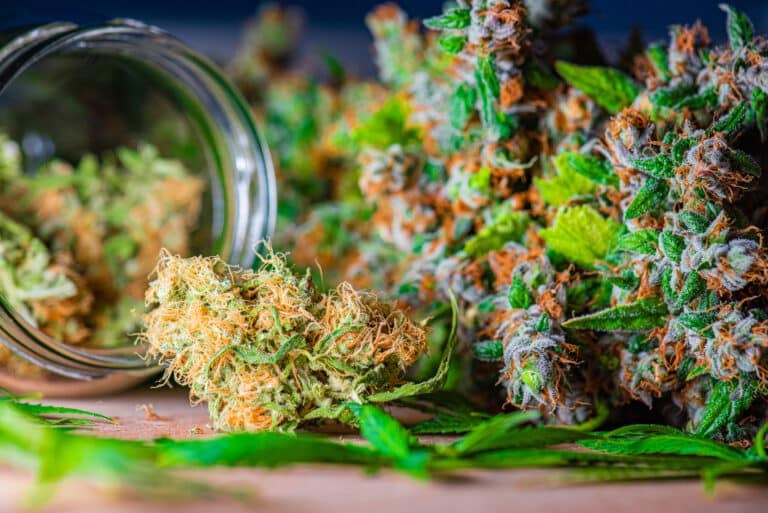
A QP is a lot of cannabis — enough to fill multiple glass jars or several sizable resealable bags. Because the volume depends on how dense the specific flower is and how well it has been trimmed, two QPs of different strains can take up noticeably different amounts of physical space. But for scale, here are some everyday comparisons often used to describe the weight of a quarter pound:
- Roughly the weight of a standard stick of butter (exactly 4 ounces in the US)
- About the weight of a medium apple or small avocado
- Slightly heavier than a deck of playing cards
- Equivalent to four separate ounce-sized jars of flower
The physical volume is much larger than any of those comparisons suggests, because cannabis flower is relatively low-density compared to butter or fruit. Expect a QP of flower to take up two or three large handfuls of volume even when packaged efficiently.
How Many Joints, Blunts, or Bowls Come From a QP?
For consumers trying to figure out how long a quarter pound would last, here is the practical math on yield:
- Half-gram joints: A QP yields approximately 225 joints
- Full-gram joints: A QP yields approximately 113 joints
- Standard blunts (around 1.5 to 2 grams each): A QP yields 56 to 75 blunts
- Typical bowl packs (around 0.25 to 0.5 grams each): A QP yields 225 to 450 bowls
For context, even a daily consumer smoking one gram per day would take roughly four months to work through a QP. This is part of why bulk quantities are typically handled by commercial operators rather than personal consumers — flower simply does not stay at peak quality that long without careful storage.
QP vs. Quarter: Avoiding the Biggest Weed Measurement Mistake
This is the most common source of confusion in cannabis measurements, and it is worth pausing on because the difference is significant.
When someone in a dispensary or casual conversation says “quarter,” they are almost always referring to a quarter ounce, which is 7 grams. This is a standard consumer amount — enough for about a week of moderate use for many people.
A “QP” or “quarter pound” is an entirely different quantity — 113 grams, or about 16 times larger than a quarter ounce. If you are shopping at a Massachusetts dispensary and see something labeled a “quarter,” it is definitely a quarter ounce, not a quarter pound. Dispensary menus typically list weights explicitly (3.5g, 7g, 14g, 28g) to remove any ambiguity.
Quick Reference: Quarter vs. QP
- A “quarter” (quarter ounce): 7 grams · Typical dispensary purchase · Roughly 14 joints
- A “QP” (quarter pound): 113 grams · Commercial/bulk quantity · Roughly 225 joints
How Much Does a QP of Weed Cost?
Since dispensaries in legal states typically cap consumer transactions at one or two ounces, pricing for a full quarter pound usually reflects wholesale or bulk rates rather than consumer retail. Reported pricing ranges vary widely depending on quality, region, and market conditions:
- Mid-grade flower: $400 to $800 per QP in legal bulk markets
- Top-shelf flower: $1,000 to $1,600+ per QP
- Per-gram equivalent: Roughly $3.50 to $14 per gram in bulk, compared to $10 to $20 per gram at consumer-facing prices
In Massachusetts, you will not see QP pricing at any licensed dispensary because the state purchase limit for adult-use consumers is well below a quarter pound. The real cost-per-gram comparison for a Massachusetts consumer is between buying an ounce at once versus splitting purchases into eighths or quarters — where the ounce is almost always the better per-gram value.
Is a QP of Weed Legal to Buy in Massachusetts?
No. A QP of cannabis is well above the adult-use purchase and possession limit in Massachusetts, so licensed dispensaries cannot sell you a quarter pound in a single transaction.
Here is the current state of Massachusetts cannabis law for adults 21 and older as of April 2026:
- Public possession limit: 2 ounces (doubled from 1 ounce under H.5350, which Governor Healey signed on April 19, 2026)
- Home possession limit: 10 ounces (anything over 2 ounces at home must be stored in a locked container)
- Single-transaction purchase limit: 2 ounces of flower, or the equivalent in concentrate (10 grams active THC) or edibles (1,000 mg THC)
- Home cultivation: Up to 6 plants per adult, 12 per household with 2 or more adults
Even under the new doubled limit, a QP (113 grams / 4 ounces) is twice the public possession cap. Licensed dispensaries in Massachusetts are legally required to enforce these limits, and Metrc, the state’s seed-to-sale tracking system, is calibrated to the current 2-ounce cap. If you see a Massachusetts dispensary advertising a quarter pound as a single purchase, that is a red flag — it is not a compliant transaction.
For a deeper dive on the new Massachusetts cannabis law and how it changes what you can buy in a single visit, see our complete guide to the 2026 Massachusetts cannabis purchase limits.
Why Do Dispensaries Use Both Grams and Ounces?
Cannabis measurement is a quirky hybrid of the metric and imperial systems. Small amounts are measured in grams — a metric unit — and larger amounts are measured in fractions of an ounce, which is an imperial unit. A pound is imperial; a gram is metric. This creates a system where an ounce is 28 grams, but a pound is 453 grams rather than a clean 448 (which you get if you multiply 28 × 16).
The reason dispensaries and consumers use both systems is simply history. Cannabis culture in the United States evolved before legalization, using imperial ounces and pounds. When precision became important for legal compliance and medical dosing, grams entered the picture because they are smaller, more precise, and internationally standardized. Today, dispensary menus almost always list both — a package will say “Eighth (3.5g)” or “Quarter (7g)” — so you get the slang term and the actual weight together.
Common Cannabis Weight Slang You Should Know
Beyond the standard measurements, cannabis culture has accumulated a deep vocabulary of slang terms for different weights. Here are the ones you are most likely to hear:
- Dime bag / Dime: Historically $10 worth of cannabis; roughly 0.5 to 1 gram
- Dub / Dub sack: $20 worth, roughly 1 to 2 grams depending on market
- Gram / G: Exactly 1 gram; the smallest standard dispensary purchase
- Eighth / Slice / “E”: 1/8 ounce or 3.5 grams
- Quarter / Quad / Q: 1/4 ounce or 7 grams
- Half / Half-O / Half zip: 1/2 ounce or 14 grams
- Ounce / Zip / O / Lid: 1 ounce or 28 grams
- QP / Quad pound: Quarter pound or 113 grams
- Half pack / Half pound: 1/2 pound or 226 grams
- Pound / Elbow / Pack / Pizzle: 1 pound or 453 grams
In a licensed dispensary setting, budtenders generally default to precise weights rather than slang, though most of our Guides at Canna Provisions will happily translate either direction. If you are not sure what to ask for, just describe what you want — “enough for about a week” or “something to try out” — and we can match you to the right size.
Frequently Asked Questions About QPs and Cannabis Weights
How many grams are in a QP of weed?
A QP of weed contains approximately 113 grams (precisely 113.4 grams). Some industry sources round down to 112 grams. Either way, a QP equals exactly 4 ounces or one quarter of a pound.
How many ounces are in a QP?
A QP (quarter pound) contains exactly 4 ounces. A full pound contains 16 ounces, and one quarter of 16 is 4.
What does QP stand for in weed terms?
QP stands for “quarter pound.” It is cannabis slang for a bulk quantity of 113 grams or 4 ounces — one fourth of a pound.
How much is a quarter pound of weed compared to a quarter?
A “quarter” in cannabis language typically refers to a quarter ounce (7 grams), which is a standard consumer purchase. A “quarter pound” or QP is 16 times larger at 113 grams. These two terms are easy to confuse but refer to very different amounts.
Can you legally buy a QP of weed in Massachusetts?
No. The Massachusetts adult-use purchase limit is 2 ounces (doubled from 1 ounce in April 2026 under H.5350). A QP is 4 ounces, which is twice the legal single-transaction limit. Licensed Massachusetts dispensaries cannot sell a quarter pound to recreational consumers.
How much does a QP of weed cost?
QP pricing varies widely by quality, region, and market. Reported ranges run from $400 to $800 for mid-grade cannabis up to $1,000 to $1,600+ for top-shelf flower in legal bulk markets. Consumer-facing per-gram pricing at dispensaries is usually significantly higher than bulk wholesale pricing.
How long would a QP of weed last?
For a daily consumer smoking one gram per day, a QP would last roughly 113 days — just under four months. For someone smoking less frequently, a QP could last much longer, though cannabis flower generally begins losing freshness and potency after about six months even with proper storage.
How many joints can you roll from a QP?
A QP of weed can yield approximately 225 half-gram joints or 113 full-gram joints. If you are rolling blunts (typically 1.5 to 2 grams each), a QP produces 56 to 75 blunts.
Is a QP the same as a quad?
Sometimes. “Quad” most commonly refers to a quarter ounce (7 grams) and is short for “quarter.” In a small number of regional dialects, “quad pound” is used as slang for a quarter pound. If someone mentions a “quad” in cannabis conversation, they almost certainly mean 7 grams, not 113 grams.
What is the legal limit of weed I can buy in Massachusetts in 2026?
As of April 19, 2026, adults 21 and older can purchase and possess up to 2 ounces (about 56 grams) of cannabis flower in Massachusetts, or the equivalent in concentrate (10 grams active THC) or edibles (1,000 mg THC). You can keep up to 10 ounces at home, with anything over 2 ounces stored in a locked container.
How many grams are in a pound of weed?
A pound of cannabis contains 453 grams (technically 453.6 grams) or 16 ounces. A pound of weed is typically a commercial quantity handled by cultivators, wholesalers, and distributors rather than by individual consumers.
Shop the Right Amount at Canna Provisions
An eighth, a quarter, a dime, a slice, a zip — people use all kinds of lingo to describe how much weed they have or how much they are buying. Most people know one or two of these terms, but if you are new to shopping at a dispensary, it is easy to get mixed up. Do not worry about it. At Canna Provisions in Lee, Holyoke, and Pittsfield, our Guides are happy to walk you through exactly what you are getting — no social anxiety required, no dumb questions, no weirdness.
Under Massachusetts’ new 2-ounce limit (effective April 19, 2026), you can now stock up on twice as much flower in a single visit as you could under the old law. That is the equivalent of 56 grams, or 16 eighths, or 8 quarters, or 2 full ounces. Still not a QP, but a significantly larger haul than what Massachusetts allowed a week ago.
Visit Canna Provisions: Lee, MA | Holyoke, MA | Pittsfield, MA
Browse our menus: Lee Menu | Holyoke Menu | Pittsfield Menu
Please consume responsibly. Cannabis products are for adults 21 and older. This product may cause impairment and may be habit-forming. Do not operate a vehicle or machinery under the influence of this drug. This information is for general educational purposes only and does not constitute legal advice. For specific legal questions about Massachusetts cannabis law, consult a qualified attorney or the Massachusetts Cannabis Control Commission.
Related Reading
Canna Provisions © 2026
Site by CannaPlanners